Case Study: From Vision to Institutional Form
The Ai Weiwei Center for Humanity is the brainchild of the iconic artist and activist Ai Weiwei. The Center is an effort to translate decades of artistic and activist practice into a vehicle for engaging people around the world in human rights issues, anchored by his global reputation and body of work. When I came in, the project had conviction at its core, partners beginning to circle, and a team preparing to move from concept into research and design. There was no obvious precedent. An artist-led institution of this scope and intent did not have a clean reference model to point to.
Challenge:
Three audiences needed to see the same thing, and they had different evidentiary standards. The general public needed something emotionally and conceptually accessible. Corporate, foundation, and individual partners needed governance-readable, risk-readable, value-prop-readable framing. Ai and his team needed the artistic and political integrity preserved without dilution. These weren't always pulling the same direction. The gap between them was the work.
Constraints:
A high-profile founder. Working with a politically exposed artist who had been censored, surveilled, and exiled meant that partner risk tolerance was a live variable. The framing had to be defensible across geographies and politically careful constituencies without becoming defanged.
Founder authority. Whatever I produced had to read as Ai's, not as a positioning exercise around him. His creative voice was non-negotiable.
Pre-launch phase. Every artifact had to do the work of an institution that did not yet exist. There was no operating history, no proof points, no public surface to point to. The materials themselves were the proof of seriousness.
International scope. With a planned site in Berlin and partners across geographies, no single cultural, regulatory, or audience frame applied.
Approach:
The work moved at high velocity, across global time zones, with multiple workstreams active in parallel. The executive director and I held three considerations simultaneously:
What would engage a general audience encountering this work for the first time?
What would give corporate, foundation, and individual partners enough to commit?
What would Ai recognize as faithful to his vision?
An early and consequential intervention was on timeline. The team was prepared to move toward physical build — site, infrastructure, public footprint — before the conceptual foundation had buy-in from key stakeholders. We reset the timeline so that strategic narrative, brand foundation, and stakeholder alignment came first, and the physical build followed from a position partners had already endorsed.
Results:
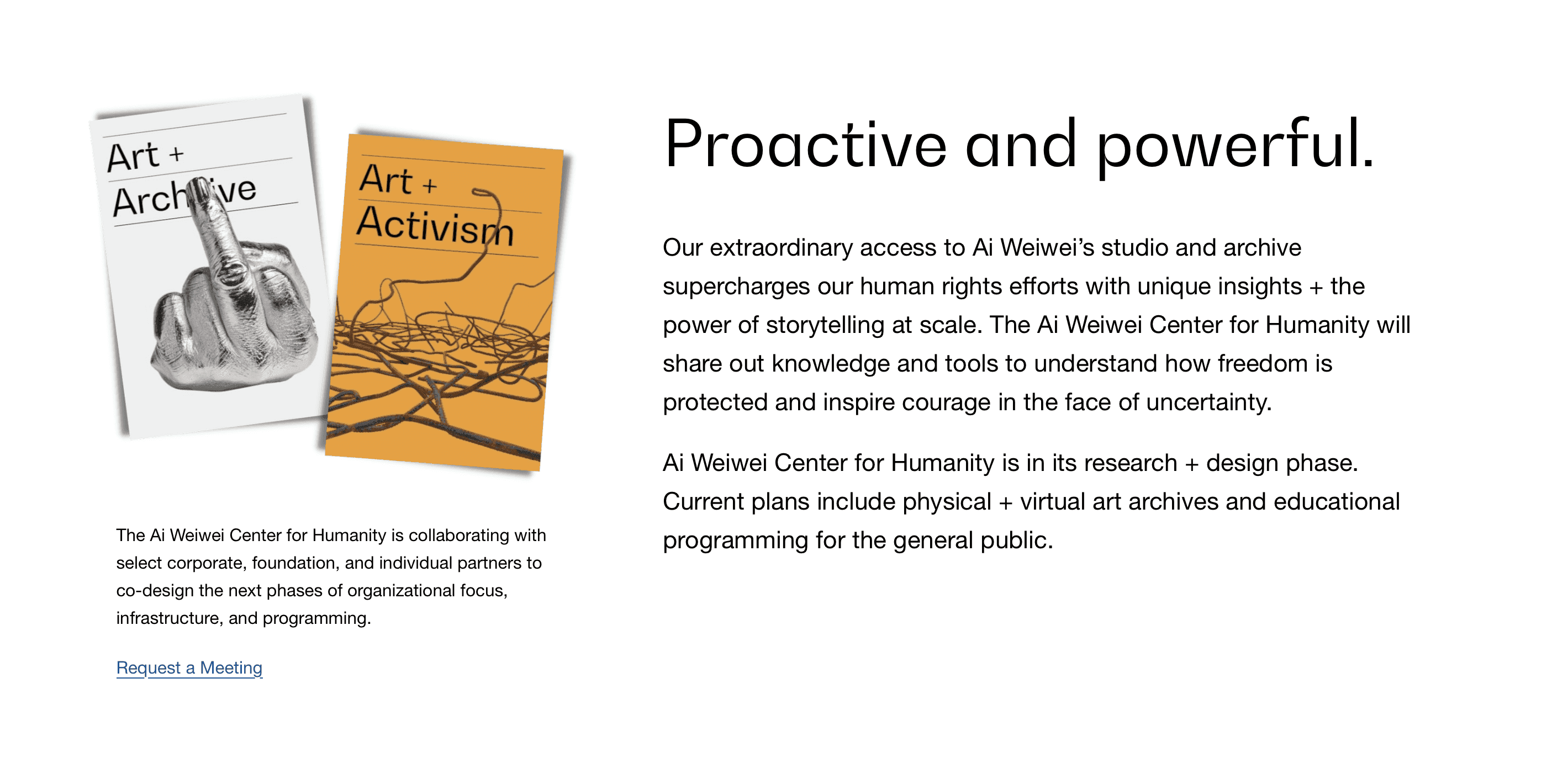
By the close of my engagement, Ai's team had a stakeholder-ready version of the project to take into foundational conversations: a preliminary brand book to anchor governance and board discussions, a messaging strategy to enter partner conversations from a coherent position, and a landing page calibrated to the project's actual phase, present enough to point to, contained enough not to overpromise. The team could forge corporate, foundation, and individual partnerships from a defensible starting point rather than improvising the pitch each time.
The Center's work continues; further development belongs to Ai and his team.
There is literally no one else I would entrust with our uniquely ambitious enterprise.
We're doing something unprecedented. It's got a lot of moving parts and we're operating in multiple industries simultaneously. Tasha's ability to help us forge a path is remarkable. She is completely unintimidated by unknowns and complexities, remaining open-minded and curious about possibilities without becoming distracted. Because of this, we've advanced faster and more confidently than I thought possible. Tasha created the messaging and positioning that not only ignited our group of stakeholders, but gave our team its strategic focus.
- Karen Lautanen, Executive Director